Corcovado National Park Guide: How to Plan Your Visit
Planning a trip to Corcovado National Park? Learn how to choose the right station, departure point and trip
Explore how rainforest, rivers, wetlands, coastline, wildlife and human history combine to make Corcovado one of Costa Rica’s most complex protected landscapes.
By Allan Guevara
Certified Costa Rica Tour Guide · Guiding in the Osa Peninsula since 2009
Updated August 2026 · Natural history guide
Key facts that help explain the landscape before you walk into it.
Corcovado is often introduced through photographs of tapirs, scarlet macaws, monkeys and jaguars. But its natural history is much bigger than a list of species.
The park is a connected landscape of lowland rainforest, rivers, freshwater wetlands, beaches, mangroves and marine habitats. The animals visitors hope to see depend on those habitats, and the habitats depend on water, soils, plants, decomposition, pollination, seed dispersal and countless interactions that are easy to miss when we focus only on large wildlife.
When guiding, one of the most useful questions is not only “What animal is that?” but “Why is it here?” Forest structure, water, fruiting trees, tides, light and season can explain much of what we observe.
— Allan Guevara, Certified Costa Rica Tour Guide
Corcovado contains several habitat types within a relatively compact area, creating transitions that are central to its biodiversity.
Humid tropical forest creates vertical layers from forest floor to canopy. Large trees, palms, lianas, epiphytes and decomposing wood provide food and shelter across many niches.
Streams, rivers and freshwater wetlands move water, nutrients and sediment through the landscape while creating habitat for fish, amphibians, reptiles, birds and mammals.
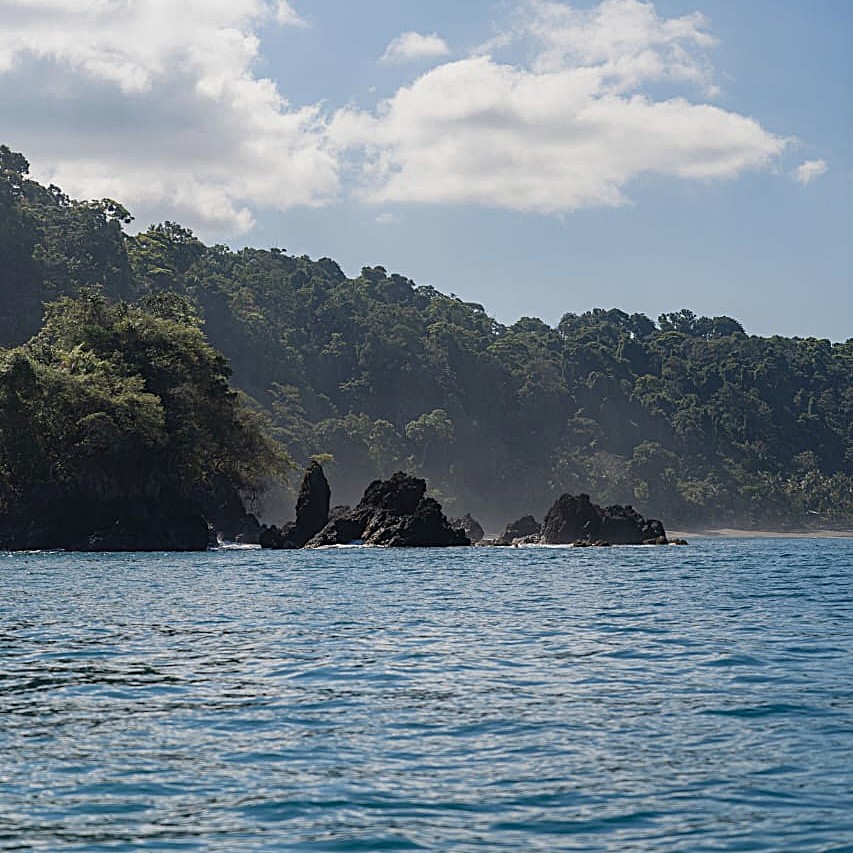
Beaches, rocky shore, mangroves and the adjacent marine environment connect terrestrial and ocean systems. Tides and coastal processes shape where species feed, nest and move.
Water is one of the forces that makes Corcovado what it is. Rainfall feeds rivers, saturates soils, influences trail conditions and supports the humid forest communities for which the park is known.
High rainfall supports evergreen forest and intense biological activity, while the timing and amount of rain influence rivers, trails and seasonal conditions.
Rivers transport water and nutrients, create aquatic habitat and form natural boundaries and travel corridors for wildlife.
Freshwater, tides, beaches and marine conditions interact along the Pacific edge, creating another layer of ecological complexity.
A tropical rainforest is not one uniform wall of green. Different layers receive different amounts of light, wind and moisture, and each layer supports different organisms.
Leaf litter, fungi, roots, insects and decomposers recycle nutrients rapidly. Tracks, fallen fruit and feeding signs often reveal wildlife that is not immediately visible.
Young trees, palms, shrubs and shade-adapted plants create dense structure used by insects, amphibians, reptiles, birds and mammals.
The canopy is a major arena for feeding, movement and competition. Monkeys, birds, epiphytes and countless invertebrates occupy this sunlit layer.
When a tree falls, light reaches the forest floor and the gap begins a new cycle of growth. Disturbance is part of rainforest dynamics, not simply damage.
Different departure points connect travelers with different sectors and travel styles. Choose the route that fits your itinerary and the landscape you want to experience.
Corcovado supports an exceptional diversity of mammals, birds, reptiles, amphibians, insects and other organisms. SINAC describes the park as protecting roughly 2.5% of the world’s biodiversity.
Large mammals receive much of the attention, but the forest works because of relationships across many scales: insects pollinate flowers, animals disperse seeds, predators influence prey behavior, fungi decompose organic matter and rivers connect terrestrial and aquatic food webs.
Wildlife sightings vary from day to day. Natural history helps make every walk meaningful because even when a particular species does not appear, the evidence of ecological processes is everywhere.
A good natural-history walk is full of relationships rather than isolated species.
Seed dispersal: mammals and birds move seeds away from parent trees, influencing future forest structure.
Predation: predators and prey shape each other’s behavior, movement and habitat use.
Pollination: insects, birds and bats connect flowering plants with reproduction.
Decomposition: fungi, insects and microorganisms return nutrients from dead material to the living forest.
Water connections: rivers and wetlands move nutrients and provide habitat that links forest and coast.
Corcovado’s present-day forest cannot be understood without people. The Osa Peninsula has a long human history, and in the twentieth century the region faced growing pressure from settlement, agriculture, logging and gold mining.
Corcovado National Park was established in 1975. Protection did not erase human influence overnight; conservation has involved decades of management, enforcement, research and relationships with surrounding communities.
Today, conservation challenges extend beyond the park boundary. Wildlife depends on connectivity with surrounding forests and biological corridors, especially as landscapes and climate conditions change.
Visitors are part of this story too. Well-managed tourism can support local livelihoods and conservation, but access and behavior must be regulated so that tourism does not become another source of ecological pressure.
Natural history becomes much more visible when you slow down and look for evidence rather than waiting only for a large animal to appear.
Guide’s tip: The slower you walk, the more natural history becomes visible.
Those questions turn a hike into a natural-history experience.
Certified Costa Rican tour guide, guiding since 2009. Allan works primarily in Corcovado National Park, the Osa Peninsula and Costa Rica’s South Pacific, guiding in Spanish, English and German.
This guide combines official park information with practical natural-history interpretation developed through years of guiding in the region.
Corcovado National Park was established in 1975. SINAC currently lists 42,560 hectares of terrestrial area and 3,354 hectares of marine area.
SINAC identifies a variety of ecosystems including forests, beaches, coral reefs, mangroves and freshwater marshes.
Its location on the Osa Peninsula, humid climate, large protected forest, rivers, wetlands, coast and range of connected habitats create many ecological niches.
No. Large mammals are highly visible symbols, but plants, insects, fungi, amphibians, reptiles, birds and aquatic organisms are all essential parts of the ecosystem.
No. Corcovado National Park is nationally protected by Costa Rica, but it is not currently inscribed as a UNESCO World Heritage Site.
A guide can help connect tracks, sounds, plants, behavior and habitat so the walk becomes about ecological relationships rather than only identifying species.
Park statistics, management information and conservation status should be rechecked during major future updates.
Continue exploring Corcovado wildlife, planning and natural-history guides from the Osa Peninsula.
Planning a trip to Corcovado National Park? Learn how to choose the right station, departure point and trip
Discover the Northern Tamandua in Corcovado National Park, including its feeding habits, climbing adaptations, behavior, ecological role and
Choose a Corcovado route that fits your itinerary and explore the rainforest with certified guides who connect wildlife sightings with the habitat and natural history around them.