Corcovado National Park Guide: How to Plan Your Visit
Planning a trip to Corcovado National Park? Learn how to choose the right station, departure point and trip

Learn how to recognize the Northern Tamandua, understand its climbing adaptations, feeding behavior and ecological role, and know what to expect if you encounter one in Corcovado.
By Allan Guevara
Certified Costa Rica Tour Guide · Guiding in the Osa Peninsula since 2009
Updated August 2026 · Wildlife field guide
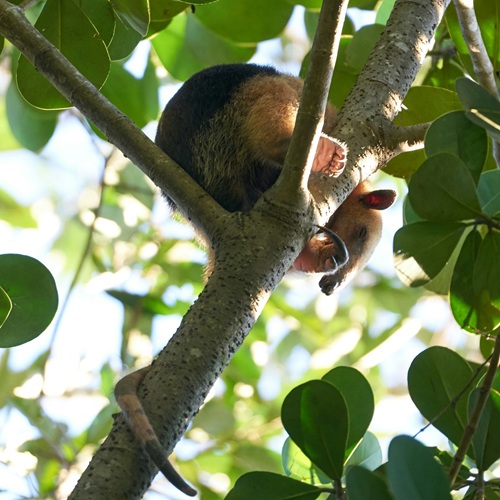
Quick facts about one of Corcovado’s most distinctive rainforest mammals.
The Northern Tamandua (Tamandua mexicana) is one of the most distinctive mammals you may encounter in Corcovado National Park. Its long snout, powerful forelimbs and prehensile tail are all part of a body built for finding ants and termites in a three-dimensional rainforest.
It is often called an anteater, but it should not be confused with the much larger giant anteater of South America. In Costa Rica, the Northern Tamandua is the familiar medium-sized species that moves both through trees and across the forest floor.
Tamanduas can move quietly above eye level, using branches almost like a second trail system. When guiding, it is worth scanning trunks, vines and canopy gaps—not only the trail ahead.
— Allan Guevara, Certified Costa Rica Tour Guide
A tamandua looks unusual because nearly every visible feature reflects its specialized way of feeding and climbing.
The narrow, elongated head and small mouth are adapted for reaching into insect nests rather than chewing large food items. Tamanduas have no teeth.
The muscular tail can grip branches and works almost like an extra limb while climbing. The underside provides better contact with bark and branches.
Large curved claws help tear into ant and termite nests and also support climbing. On the ground, the animal protects these claws by walking differently from a flat-footed mammal.
The Northern Tamandua is a specialist. Its anatomy makes much more sense when you see how feeding, climbing and defense all work together.
A long tongue reaches into narrow galleries inside ant and termite nests, collecting insects rapidly before the colony can mount a full defense.
The prehensile tail stabilizes the animal on branches and frees the forelimbs for climbing or opening insect nests.
The same foreclaws used for feeding can be formidable in defense. A tamandua should always be observed from a respectful distance.
Northern Tamanduas are specialized insectivores that feed mainly on ants and termites. They use smell to locate colonies, open nests with strong forelimbs and collect insects with a long tongue coated in sticky saliva.
A tamandua usually feeds for a limited time before moving on. This reduces exposure to defensive insects and allows it to visit multiple feeding sites.
Tamanduas do not chew insects with teeth. Their feeding system is adapted to swallowing small prey rapidly.
The long snout is not only visually distinctive. Scent is central to locating hidden insect colonies in wood, soil and vegetation.
Field note: feeding signs such as opened rotten wood can tell a guide that an insect-eating mammal has been active, even when the animal itself is no longer visible.
Tamanduas use both trees and the forest floor. An encounter can happen in different sectors, but wildlife is wild and no route can guarantee a sighting. Choose your Corcovado route for the overall experience, not for a promise of one species.
Northern Tamanduas are generally solitary outside the mother-young relationship. They may be active during both day and night, and activity can vary with local conditions.
They move through trees with deliberate climbing movements but also travel on the ground between feeding areas. A mother may carry her young on her back during the dependent period.
If you encounter one resting or moving slowly, give it space and let it choose its own route. The goal is to observe natural behavior rather than change it.
Ants and termites are major components of tropical ecosystems, and the Northern Tamandua is one of the mammals specialized to exploit that abundant food source.
By feeding on social insects, tamanduas participate in the forest food web while also serving as prey for larger predators. Their presence is one small part of a much larger network of interactions among insects, trees, predators and decomposers.
The value of seeing a tamandua is not only the animal itself—it is understanding the ecological niche it represents.
A tamandua may look slow, but it is a capable climber. Its tail, forelimbs and claws allow it to move through branches that would be difficult for many mammals of similar size.
For visitors, the practical lesson is simple: never crowd, corner or touch a tamandua.
A good wildlife encounter is one in which the animal can continue behaving naturally.
Important: Park rules and guide instructions always take priority during a wildlife encounter.
A calm encounter usually reveals more than a rushed one.
Certified Costa Rican tour guide, guiding since 2009. Allan works primarily in Corcovado National Park, the Osa Peninsula and Costa Rica’s South Pacific, guiding in Spanish, English and German.
This field guide combines reliable species information with practical observations from years of guiding travelers in rainforest environments.
The species commonly encountered is the Northern Tamandua (Tamandua mexicana), a medium-sized anteater found from southern Mexico through Central America into northwestern South America.
They can be active during both day and night. Activity varies, so describing them as strictly nocturnal is too simple.
They are strong climbers and spend substantial time in trees, but they also travel and forage on the forest floor.
Their diet is specialized mainly on ants and termites, which they locate largely by smell and collect with a long sticky tongue.
They normally avoid confrontation, but their powerful foreclaws can be used defensively. Visitors should never approach, corner or touch one.
No. Tamanduas are wild animals and sightings cannot responsibly be guaranteed.
Taxonomy and conservation status should be rechecked during major future updates.
Continue exploring Corcovado wildlife and natural-history guides from the Osa Peninsula.
Planning a trip to Corcovado National Park? Learn how to choose the right station, departure point and trip
Explore the natural history of Corcovado National Park and discover how rainforest, rivers, wetlands, coastline and wildlife interact
Choose the route and trip length that fit your itinerary, then explore Corcovado with certified local guides who focus on wildlife observation and rainforest interpretation.